
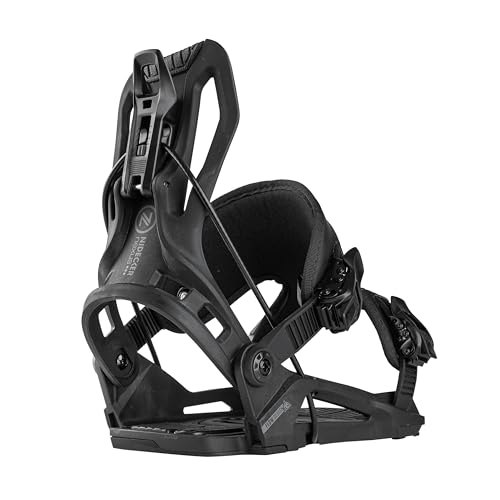


Flow Nexus Snowboard Bindings | Rear-Entry Performance
The Flow Nexus bindings deliver our signature Speed Entry system with a dialed-in highback engineered for all-mountain precision. Drop in, lock your heel, and ride — no fumbling with traditional straps on cold chairlift unloads. We built the Nexus around an Active Strap Technology chassis that wraps your boot the moment you recline the highback, pairing one-step convenience with edge-to-edge response.
Whether you're lapping park features or tracking groomers at speed, the Nexus offers tool-free forward-lean adjustment and a rockered baseplate that balances board feel with shock absorption. This binding suits riders who want rear-entry efficiency without sacrificing control, making every lift lap faster and every carve more confident.
Nexus Tech Specs
Speed Entry System & Strap Integration
The Nexus uses our second-generation Speed Entry mechanism — a hinged highback that reclines to let you slide your boot in from behind, then snaps upright to lock your heel and auto-cinch the straps. Once you recline the highback, Active Strap Technology deploys the Fusion PowerStrap and LSR ankle strap around your boot in one motion, eliminating the manual tightening step traditional bindings require.
This integration means the straps ride at pre-set tension calibrated to your boot size, so every entry feels identical whether you’re dropping in on run one or run twenty. The system shaves seconds off each lift unload and removes the awkward balancing act of bending over to fasten buckles in deep powder or on a crowded catwalk.
Baseplate Flex & Board Connection
We designed the N-Connect rockered baseplate to mirror your board’s natural flex pattern rather than fighting it. The rocker profile places contact points under the ball and heel of your boot while the center arch lifts slightly, letting the board bend through its camber without a stiff binding fighting back. This translates to smoother turn initiation and less leg fatigue on long days.
The baseplate accepts both 4×4 and 2×4 insert patterns, so you can mount the Nexus on any deck in your quiver. Four independent mini-disk mount points distribute load evenly across the board, reducing pressure cracks and giving you millimeter-level stance adjustment without tools — just loosen the lever, slide the binding, and lock it down.
Highback Geometry & Forward Lean
Highback Design
The Nexus highback stands 27 centimeters tall with a mid-stiffness spine that supports aggressive carving without punishing you on mellower terrain. We shaped the lateral wings to wrap around your calf for even pressure distribution, and the top edge features our SpineGrip texture so your hand finds purchase when you grab the binding to strap in.
Adjustable Forward Lean
A tool-free ladder on the highback’s spine lets you dial forward lean from zero to fifteen degrees in three-degree increments. Riders who prefer a more upright stance for park laps can zero out the lean, while those charging steep terrain or hardpack can crank it forward for instant heel-edge engagement. The ratchet locks firmly enough that it won’t shift mid-run, yet you can adjust it barehanded between laps.
More Flow Rear-Entry Options


Rated 4.8 by verified buyers


Common Questions About the Nexus Binding
Traditional bindings require you to buckle two or three straps manually every time you strap in. The Flow Nexus bindings use a hinged highback that reclines so you step into the binding from behind, then the highback snaps upright and the Active Strap Technology auto-cinches both straps in one motion. You set your preferred strap tension once, and every subsequent entry takes about three seconds with no bending or fumbling.
The system saves time on every lift unload and eliminates the balancing act of tightening straps while standing on one foot. Once you're locked in, the hold feels identical to a traditional binding because the same Fusion PowerStrap and LSR ankle strap wrap your boot — the only difference is how you get there.
Yes, the Nexus works with virtually every major boot brand including Burton, Vans, ThirtyTwo, Ride, Salomon, DC, and K2. The open-toe design accommodates different boot shapes, and the adjustable toe ramp lets you center any boot over the binding's mounting point.
If you ride a particularly wide boot or an oversized fit, size up one binding size and use the toe-ramp slider to fine-tune centering. We test compatibility annually across dozens of boot models, and the only boots that occasionally cause issues are extremely bulky freeride boots with thick rubber rand extensions — even those usually work fine in the large binding size.
The Nexus sits at a medium flex rating of six out of ten, making it versatile enough for all-mountain riding from park laps to groomer carving. The highback is stiffer than our entry-level models but softer than the expert-focused NX2, so it supports aggressive turns without punishing you on mellow terrain or buttery presses.
This flex range works well for intermediate to advanced riders who want one binding that handles mixed terrain throughout the day. If you spend most of your time in the park or jibbing, the Fuse binding offers a softer playful flex, while the NX2 delivers race-level stiffness for charging steep lines.
The Nexus features a tool-free forward-lean ladder on the highback spine with settings from zero to fifteen degrees in three-degree increments. To adjust it, pull the locking tab at the base of the highback spine, slide the ladder to your desired angle, and release the tab to lock it in place.
You can make this adjustment barehanded between runs, so it's easy to dial in more forward lean for hardpack days or zero it out for park sessions. The ratchet mechanism locks firmly enough that it won't shift during riding, even on hard landings or aggressive carves.
A flat baseplate sits uniformly against the board, creating a stiff connection that can dampen the deck's natural flex. The N-Connect rockered baseplate on the Nexus has contact points under the ball and heel of your boot with a slight arch in the center, allowing the board to flex through its camber profile more naturally.
This rocker design improves turn initiation because the binding doesn't fight the board's bend, and it absorbs vibration better on chattery snow or hardpack. You get a more lively board feel without sacrificing edge control, which makes the Nexus responsive across varied terrain conditions.
Yes, the Nexus is compatible with both 4×4 and 2×4 insert patterns, covering virtually every snowboard on the market. The binding uses four independent mini-disk mounting points that distribute load evenly and let you adjust stance width in millimeter increments without moving your boot position on the binding itself.
The stance adjustment is tool-free — just loosen the lever on each disk, slide the binding to your preferred width, and lock it down. This makes it easy to dial in your exact stance or share the bindings across multiple boards with different insert spacing.
Most riders adapt within three to five runs. The initial adjustment involves setting your strap tension and forward lean to match your boot and riding style, which takes a few minutes of trial on your first day. After that, the entry motion becomes automatic — recline the highback, step in heel-first, snap the highback upright.
The biggest learning curve is trusting the auto-cinch straps to lock down without manual tightening. Once you experience the secure hold after a few laps, the convenience becomes second nature and traditional bindings start to feel slow by comparison.