


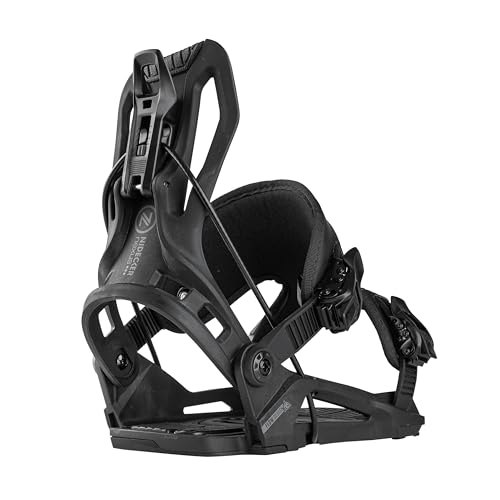
Flow Mayon Snowboard Bindings
The Flow Mayon bindings bring our signature rear-entry speed to riders who want a forgiving flex without sacrificing response. We designed the Mayon for all-mountain progression — whether you're linking turns on groomers or exploring the terrain park for the first time.
Our Lock-N-Load hiback adjusts tool-free for forward lean, so you can dial your stance on the fly. The FlowFit strap system wraps the boot evenly, and the ActiveStrap ankle belt eliminates pressure points during long days on the mountain. Built on a Fusion PowerTriangle baseplate, the Mayon transfers energy efficiently while absorbing chatter when the snow gets variable.
Mayon binding specs at a glance
SpeedEntry rear-entry design
The Mayon uses our SpeedEntry highback, which hinges down completely so you step into the binding from the rear. Once your boot is seated, simply lift the highback and lock it — no stooping, no fumbling with straps in deep snow.
This design shines on chairlift laps and cat tracks where speed matters. The Lock-N-Load lever secures the highback in place, and the Locking Slap Ratchets on both ankle and toe straps provide a final snug fit. We built this system for riders who value convenience without compromising hold — the Mayon locks down as firmly as any traditional two-strap binding once closed.
FlowFit strap system and ankle support
We engineered the FlowFit ankle strap to curve around the boot naturally, distributing pressure across a wider surface. The ActiveStrap toe belt uses a textured grip pattern that conforms to different boot profiles, so riders in low-volume slippers or burly freeride boots both get a secure wrap.
Hiback flex and forward lean
The Mayon’s hiback sits at a 4 out of 10 on our flex scale — supportive enough for carving but forgiving when you need to tweak a method. Tool-free forward lean adjustment lets you add or reduce angle on the mountain; we find most park riders leave it neutral, while groomers-focused riders dial in 5–10 degrees for quicker edge response.
Fusion PowerTriangle baseplate construction
Our Fusion PowerTriangle baseplate blends nylon composite in the frame with reinforced triangular geometry under the heel and toe. This structure routes energy from your boot sole directly to the board’s edges while allowing the center to flex for smoother turn initiation.
The baseplate is compatible with all current mounting standards — 4×4, 2×4, and Burton Channel. We include mounting discs for each pattern in the box, along with stainless hardware that resists corrosion from snow and salt. Riders switching from a different binding system will find installation straightforward; the standard four-screw layout matches most reference-stance inserts on modern boards.
More rear-entry bindings from Flow


Rated 4.8 by verified buyers


Common questions about the Mayon bindings
No, the Mayon uses Flow's SpeedEntry rear-entry system, which is not compatible with Burton Step On boot cleats. The Mayon works with any standard soft-boot snowboard boot — you step in from the rear and secure the highback and straps manually.
Burton Step On requires proprietary boot hardware that clicks into Step On–specific bindings. If you already own Step On boots, you'll need Step On bindings to use them.
Yes, the Mayon baseplate is compatible with standard four-hole and Channel mounting patterns, so it will fit most splitboard touring brackets and pucks. Keep in mind that rear-entry bindings add a few seconds to each transition compared to traditional two-strap models, since you need to flip the highback down and back up.
Many splitboarders prefer lighter, simpler bindings for touring efficiency, but if you value the convenience of SpeedEntry on resort days and occasionally tour, the Mayon will mount and ride fine on a split setup.
Both use Flow's rear-entry SpeedEntry system, but the Mayon has a stiffer highback, more robust strap system, and the Fusion PowerTriangle baseplate for better energy transfer. The Nexus is our entry-level model with a simpler single-piece baseplate and softer overall flex — it's ideal for beginners or park riders who want maximum forgiveness.
The Mayon sits in the middle of our line and appeals to intermediate riders ready for more response without jumping to a full freeride binding. If you're still learning or prioritize a buttery feel, the Nexus is the better choice. If you want to charge harder and need more support, go with the Mayon.
Tighten the ankle and toe ratchets until the boot feels snug but not constricting — you should be able to flex your ankle forward without the heel lifting. Over-tightening can create pressure points and cut off circulation, especially on long runs.
A good test is to strap in, stand up, and flex into a riding stance. If your heel stays planted and the binding moves with your boot, you're set. If you feel any slop or your heel lifts when you lean forward, click the ratchet one or two more notches. The FlowFit strap does most of the work distributing pressure, so you don't need vise-grip tension.
The Mayon sizing runs true to your boot's stated size. We recommend choosing the size that matches your boot manufacturer's sizing chart — if you wear a men's 9 boot, the Medium (7.5–10) is the correct choice.
The ActiveStrap toe belt adjusts to accommodate different boot volumes, so you have room for both low-profile freestyle boots and bulkier all-mountain models within the same binding size. If you're between sizes — say a men's 10 that could fit Medium or Large — go with the smaller size for a more responsive feel, or the larger if you plan to size up your boots in the future.
Yes, both the FlowFit ankle strap and the ActiveStrap toe belt are sold as individual replacement parts through our online service portal and authorized dealers. Each strap includes the ladder and padding, and installation takes about five minutes with a Phillips screwdriver.
The Locking Slap Ratchets and buckles are also available separately if a mechanism breaks. We design our bindings so you can replace high-wear components instead of buying a whole new set — most riders get multiple seasons out of the original straps, but having spares on hand for mid-season repairs is always smart.
The Mayon uses EVA foam padding in the ankle strap and toe belt to cushion the boot and absorb small vibrations. The baseplate itself does not include separate shock-absorbing pads or dampening inserts — it's a direct-mount design that prioritizes board feel and energy transfer.
If you want more cushioning underfoot, consider adding aftermarket footbed inserts to your boots or stepping up to our Alpha model, which includes a multi-density baseplate with integrated damping. For most all-mountain riding, the Mayon's foam padding and flex profile provide enough comfort without sacrificing response.