


Flow Snowboard Bindings – Rear-Entry Speed & Performance
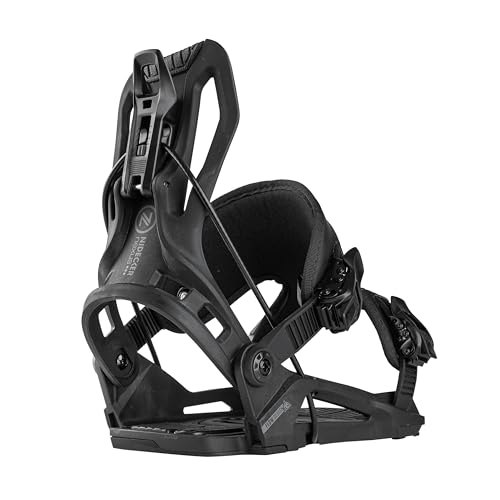
Flow snowboard bindings revolutionized the industry by eliminating the stomp-pad shuffle. Our patented rear-entry design lets you step in and lock down with one motion—no bending, no fumbling, no wasted minutes on the chairlift exit. The Active Strap Technology wraps your boot the instant you flip the highback, delivering the same power transfer as traditional two-strap systems while shaving seconds off every run.
We built Flow for riders who demand all-mountain versatility: a rockered baseplate that flexes naturally underfoot, tool-free forward-lean adjustment, and progressive-flex highbacks tuned to everything from groomers to park laps. Whether you're racing first chair or lapping the jump line, our bindings stay responsive, comfortable, and locked in all day.
Active Strap Technology & Rockered Baseplate
How Rear-Entry Speed Works
Traditional strap bindings require two separate ratchet operations—ankle first, toe second, both leaning over while your friends wait. Flow eliminates that choreography. You step onto the baseplate, flip the highback upright, and the Active Strap system cinches simultaneously around your ankle and toe box. The locking highback holds everything in place, so every edge transition transfers energy as cleanly as a conventional setup.
The system isn’t automatic for the sake of convenience alone; it’s engineered for riders who clock twenty-plus runs a day. Shaving fifteen seconds per entry adds up to minutes saved across a session, and those minutes mean more powder laps, more jumps, or simply more time riding instead of fiddling. The NX2 and Nexus models refine this mechanism with indexed forward-lean stops and asymmetric strap geometry, so every flip delivers the same secure lock every time.
Active Strap Technology Explained
Active Strap Technology is our answer to the skeptic who assumes speed equals slop. Each strap features a dual-density construction: a stiff outer spine that maintains shape under load, and a soft inner lining that molds to your boot’s contours. When you close the highback, both straps pivot inward from anchor points engineered to match boot flex zones—not generic hole patterns.
Asymmetric Design for True Heel Hold
Our ankle strap sits lower on the medial side to prevent heel lift during toeside carves, while the toe strap uses a stepped ramp that pulls your forefoot back into the highback pocket. This asymmetry mirrors the natural shape of a snowboard boot, so you’re not forcing a symmetrical frame onto an asymmetrical object. Combined with the rockered baseplate, the straps flex with your boot’s natural forward roll rather than fighting it, reducing fatigue on long traverses and keeping your stance neutral on jumps.
Baseplate Construction & Compatibility
We mold every Flow baseplate from glass-filled nylon reinforced at high-stress zones with aluminum inserts. The result is a chassis that flexes longitudinally—front to back—while staying torsionally stiff laterally, so your board responds instantly to weight shifts but still forgives chop and landings. The rockered profile lifts contact points under your toes and heels, reducing painful pressure ridges that plague flat baseplates on longer rides.
Universal disc mounting means Flow bindings fit Burton Channel, 4×4, 2×4, and proprietary hole patterns without adapters. Stance width adjusts on standard half-inch increments, and rotation dials let you fine-tune your angle from duck to race without re-drilling. Tool-free forward lean clicks into 0°, 10°, or 15° positions via indexed tabs on the highback spine—no screwdriver required, even with gloves on.
Compare Our Rear-Entry Binding Systems



Rated 4.8 by verified buyers


Common Questions About Flow Bindings
No. The Active Strap Technology applies the same wrap-around pressure as dual ratchet straps, and the locking highback keeps the system rigid under load. Independent flex tests show Flow bindings deliver equivalent edge-to-edge response to strap models in the same flex category. The rear-entry mechanism affects convenience, not performance—once locked, the binding behaves identically to a traditional setup.
Many professional riders and resort instructors use Flow bindings precisely because the speed of entry doesn't come at the cost of control. If you're jumping from a stiff freeride strap binding to a soft-flex Flow model, you'll notice a difference—but that's flex rating, not the entry system.
Yes, as long as your boot fits within the binding's stated size range. Flow bindings work with soft, medium, and stiff-flex boots; the adjustable forward lean and strap micro-ratchets accommodate different boot profiles. Boots with heavily recessed heels or race-cut footprints may require shim washers to center the heel cup, but standard all-mountain and freestyle boots mount without modification.
Avoid pairing extremely stiff boots (flex 9–10) with entry-level Flow models, since the binding's flex rating should match or slightly exceed your boot's stiffness for optimal energy transfer.
Entry averages three to five seconds once you're familiar with the motion: step onto the baseplate, flip the highback upright, done. Exit is even faster—pull the highback lever and step out. First-time users may take ten to fifteen seconds while learning foot placement, but muscle memory builds quickly.
Compare that to traditional bindings, which require two separate ratchet operations per foot (roughly fifteen to twenty seconds per binding for most riders). Over a full day, Flow bindings save five to ten minutes of aggregate buckling time.
No. Once you've dialed in the strap ladders for your specific boot, the Active Strap system remembers that setting. Each time you close the highback, the straps return to the same tension automatically. You'll only re-adjust if you swap boots or if the straps loosen gradually over dozens of sessions—a quick ladder click fixes that in seconds.
This is different from traditional ratchet bindings, where some riders loosen straps between runs for comfort and must re-tighten each time.
Deep powder actually makes Flow bindings easier, since you're not bending over into waist-deep snow to reach ankle straps. Brush off the baseplate, step in, and flip—the highback design sheds snow better than open strap systems. In icy conditions, keep the baseplate rails clear of freeze-up by tapping the binding against your board before entry; the rear-entry lever can ice over if moisture accumulates, but a quick knock clears it.
Some riders apply a thin layer of silicone spray to pivot points at the start of the season to prevent ice buildup in sub-zero temperatures.
Our lineup spans entry-level to backcountry-specific. The Fuse uses a molded EVA baseplate and simplified strap for beginners; the NX2 adds Fusion PowerStrap and canted footbed for park; the Nexus incorporates carbon-reinforced highback and adjustable toe ramp for aggressive all-mountain; the Alpha features a carbon-infused baseplate and dual-zone forward lean for touring. Women's-specific models like the Minx use narrower heelcups and softer flex tuned to lighter rider weights.
All models share the core rear-entry mechanism and Active Strap Technology—the differences lie in materials, adjustability, and flex ratings.
Match your boot size to our size chart: Small fits men's 6–8, Medium 8–10, Large 10–12, X-Large 12+. If you're between sizes (e.g., size 10 boot), size up for maximum strap adjustability and future boot compatibility. Women's bindings follow the same sizing but start at Small for women's 5–7.
Measure your boot's mondo size (printed inside the liner) if you're unsure—Flow bindings reference shell length, not US shoe size, for international compatibility.